
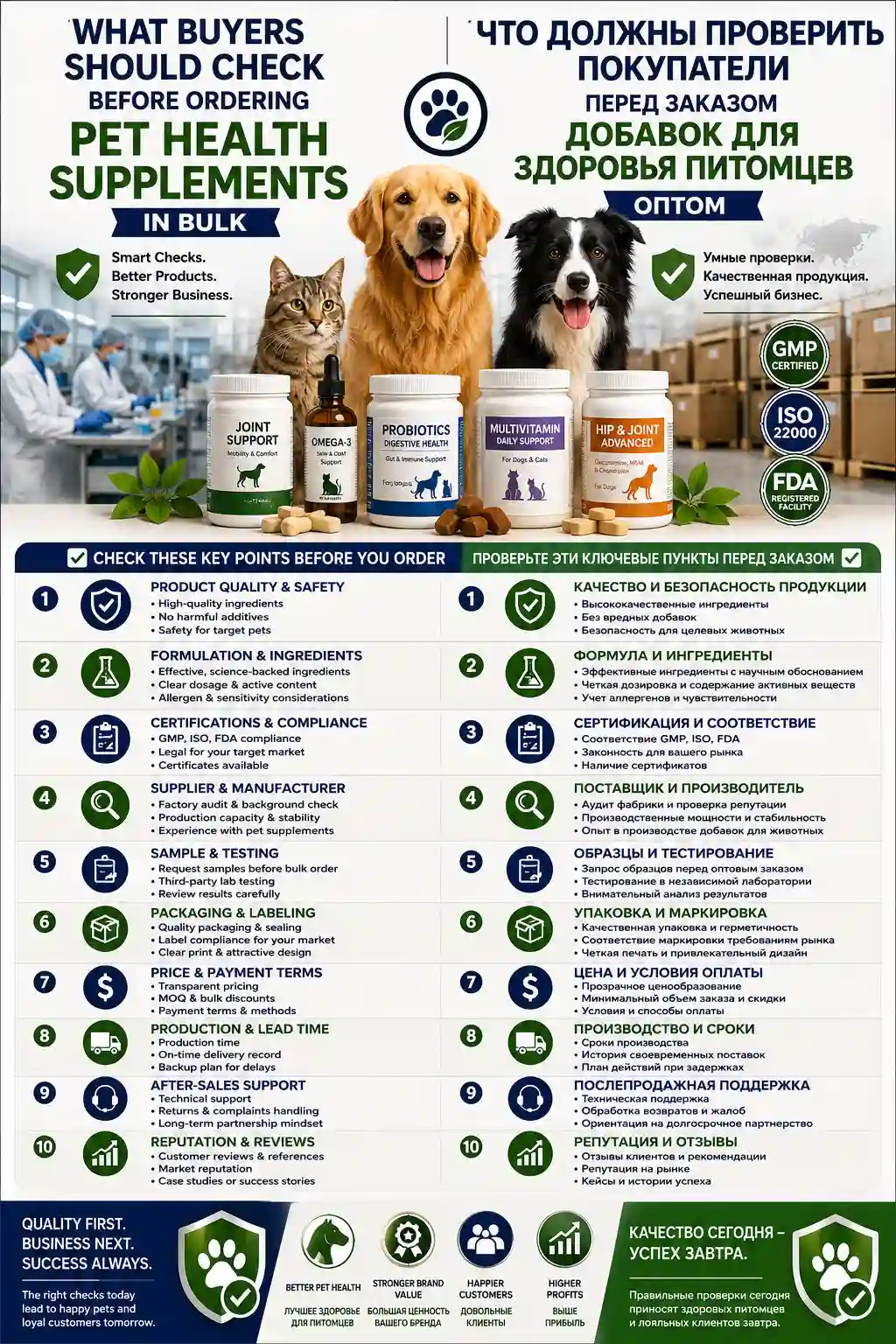
What Buyers Should Check Before Ordering Pet Health Supplements in Bulk
Placing a bulk order for pet health supplements is a big commitment. Whether you're a distributor stocking inventory or a brand owner launching your first product line, the checkpoints you hit before placing the order determine whether you end up with a profitable product or a pallet of problems.
Over the years I've seen too many buyers skip the verification steps and pay for it later. Here's a practical checklist based on real sourcing experience.
Verify the Manufacturer's Claims — Don't Just Trust the Brochure
Every manufacturer has a polished sales deck. Fewer have the documents to back it up. Before placing any bulk order, ask for and verify these four documents:
GMP or equivalent certification. For Chinese manufacturers, this means a valid SC food production license. For US facilities, current FDA facility registration. Check the expiration dates yourself — a surprising number of "certified" facilities are operating on expired paperwork.
Third-party lab test reports. These should be from accredited labs like SGS, Eurofins, or Intertek, not the manufacturer's own in-house lab. Look for specific active ingredient levels matching your formula specification.
Product liability insurance. A reputable manufacturer should carry at least USD 2–5 million in product liability coverage. If they can't provide proof, your brand is exposed.
Export documentation (if importing). For shipments from China to the US, you need a Health Certificate, Certificate of Free Sale, and Bill of Lading. Missing paperwork can hold goods in customs for weeks.
Confirm the Active Ingredient Levels Before Production
A 2024 third-party study tested 15 budget pet supplements and found that 8 out of 15 contained less than 60% of their labeled active ingredients. The worst performer had only 22% of the claimed glucosamine.
This happens because manufacturers sometimes use cheaper raw materials or cut active levels to save costs without telling the buyer. The solution is simple: require a pre-production sample tested by an independent lab, and specify that bulk production must match the sample within an acceptable tolerance — typically ±5–10% for most active ingredients.
Build this into your purchase agreement. If the final product doesn't match the approved sample within tolerance, you have the right to reject the batch.
Understand the MOQ Structure and Price Breaks
Minimum order quantities (MOQs) vary significantly by product type and manufacturer:
| Product Type | Typical MOQ | Price Break Level |
|---|---|---|
| Powder in jars | 1,000–3,000 units | 5,000+ units |
| Soft chews | 3,000–10,000 units | 10,000+ units |
| Liquid supplements | 2,000–5,000 units | 5,000+ units |
| Tablet/caplet | 5,000–20,000 units | 25,000+ units |
Most manufacturers have price breaks at tiered volumes. The per-unit cost difference between a 3,000-unit order and a 10,000-unit order is often 15–25%. If you have the cash flow and storage capacity, ordering at the next tier can significantly improve your margin.
But don't let a low unit price tempt you into over-ordering. A 2023 survey of pet supplement startups found that over 30% reported excess inventory within six months of launch because they ordered too much of a single SKU. Start with the lowest MOQ that makes financial sense, then reorder based on actual sales data.
Check Packaging Quality for Bulk Shipments
Packaging failures are one of the most common issues in bulk pet supplement orders. The problem usually isn't the packaging material itself — it's how it performs during shipping.
For bulk orders, check:
- Pouch seal strength — Heat seals should withstand at least 40 N/15mm for powder products. Weaker seals can burst during container shipping, especially in high-temperature conditions.
- Moisture barrier properties — For probiotic and powder products, the packaging should have an aluminum foil layer (not just metallized film). Without it, moisture ingress can degrade active ingredients within weeks.
- Carton strength — Export cartons should be at least triple-walled corrugated for ocean freight. Double-walled cartons collapse under stacking pressure in shipping containers.
A client once received 10,000 units of probiotic powder where the inner seals had failed during shipping. Moisture had gotten into about 30% of the jars, turning the powder into hard clumps. The manufacturer blamed "shipping conditions," but the root cause was packaging specified for domestic use, not export.
Define Quality Acceptance Criteria in Writing
"Good quality" means different things to different people. Before placing your bulk order, define and document:
- Active ingredient tolerance (±5% or ±10%?)
- Microbiological limits (total plate count, yeast, mold, E. coli, Salmonella)
- Appearance standards (color, texture, odor)
- Packaging specifications (seal strength, label placement accuracy)
These should be part of your Quality Agreement — a separate document from the purchase order. If the delivered product doesn't meet these standards, the Quality Agreement defines what happens next: discount, return, or rejection.
Plan for Lead Times and Safety Stock
Bulk orders from overseas manufacturers require patience. Typical timelines:
| Stage | Timeline |
|---|---|
| Raw material procurement | 5–10 working days |
| Production | 10–20 working days |
| Quality testing | 5–7 working days |
| Ocean freight (China to US West Coast) | 18–25 days |
| Customs clearance | 3–7 days |
| Total lead time | 45–70 days |
Most experienced buyers maintain 8–12 weeks of safety stock to cover供应链 gaps. Running out of stock while waiting for a container to arrive is expensive — you lose sales momentum and risk losing retail placements.
The Bottom Line
Bulk ordering pet health supplements is a process, not a transaction. Verify certifications, test pre-production samples, inspect packaging specifications, and document quality standards in writing before you commit. Each step I've listed here exists because someone learned the hard way what happens when you skip it. Don't be that someone.