
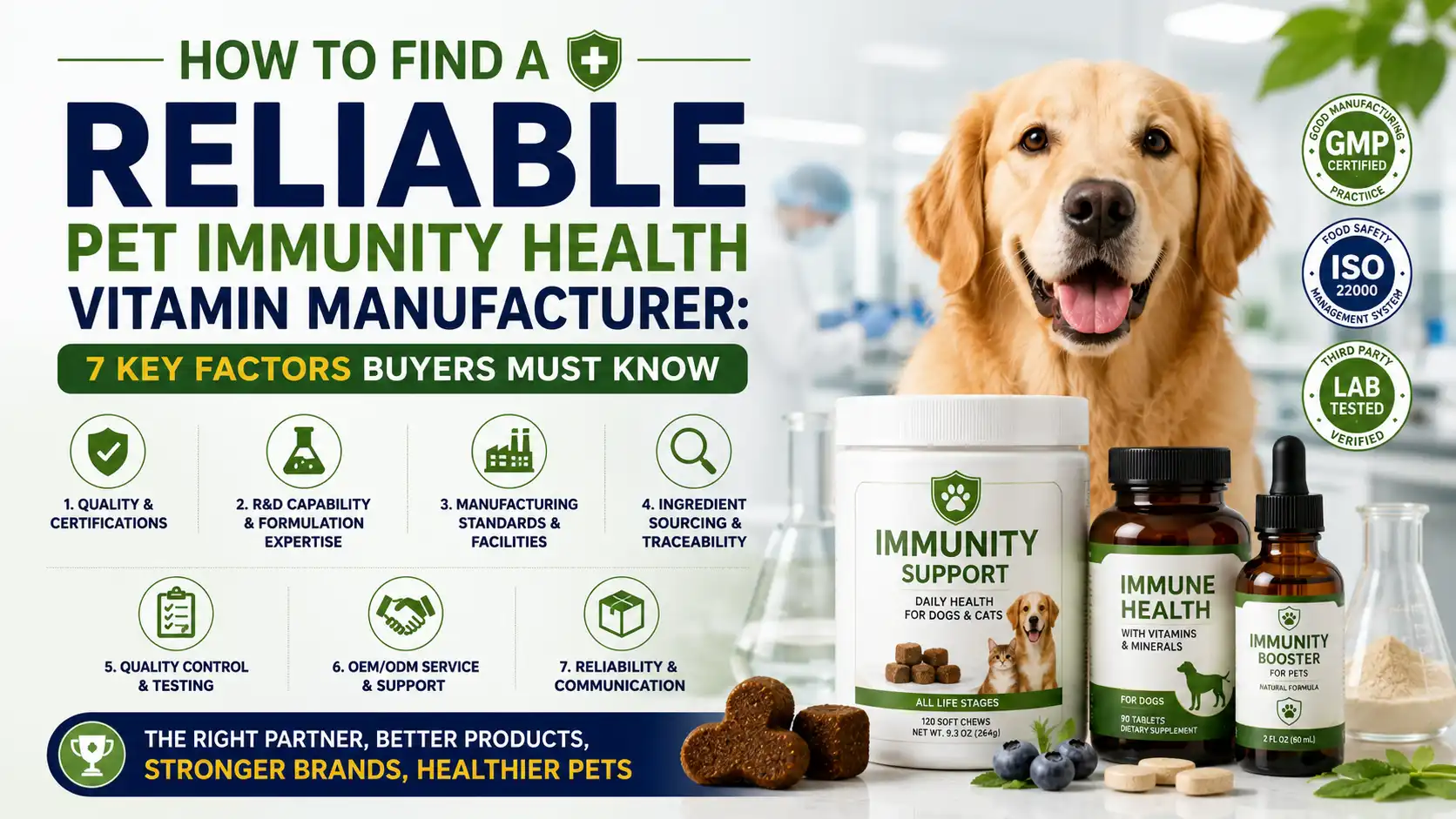
How to Find a Reliable Pet Immunity Health Vitamin Manufacturer: 7 Key Factors Buyers Must Know
Part of: Pet Immunity Supplements: A Guide for Brands, Buyers and Formulators
Quick answer
What is a reliable pet immunity health vitamin manufacturer? A reliable manufacturer is a GMP-certified facility with proven expertise in pet supplement formulation, transparent quality control processes, flexible MOQ options, and strong communication systems. They provide third-party testing, offer customization services, and maintain regulatory compliance across target markets.
Introduction: Why Manufacturer Selection Matters
Choosing the right pet immunity health vitamin manufacturer is the foundation of building a successful pet supplement business. Whether you're a retailer seeking wholesale pet immunity vitamins or a brand looking for private label customization, the manufacturer you partner with determines your product quality, compliance, and long-term success.
What decides the outcome is not the brochure. It is four things you can check before signing: certificates you can verify against the issuing body, evidence the facility can repeat a batch, records that show what went into yours, and a straight written answer to an awkward question.
This guide reveals the 7 essential factors that separate exceptional manufacturers from mediocre ones, helping you make an informed decision that protects your brand and serves pet owners effectively.
The 7 Key Factors to Evaluate
Factor 1: Quality Certifications and Regulatory Compliance
Why It Matters
Quality certifications are non-negotiable in the pet supplement industry. They demonstrate a manufacturer's commitment to safety, consistency, and regulatory adherence.
Essential Certifications to Look For:
| Certification | Scope | Importance |
|---|---|---|
| GMP (Good Manufacturing Practices) | Production processes, facility standards | Critical - FDA requirement |
| FDA Registration | US market compliance | Essential for US sales |
| NASC Quality Seal | Industry-specific animal supplement standards | Highly recommended |
| ISO 22000 / FSSC 22000 | Food safety management | International credibility |
| Organic / Non-GMO | Ingredient sourcing standards | Market differentiation |
How to Verify
1. Request current certificates (not expired)
2. Check certification body databases 3. Review inspection history 4. Ask for audit reports
Red Flags:
- Expired certifications
- Refusal to provide documentation
- History of FDA warning letters
- No third-party verification
Related Reading: Learn more about GMP certification requirements for pet supplement manufacturers.
Factor 2: Manufacturing Capabilities and Production Capacity
What to Assess
Production Forms Available
- Tablets and caplets
- Soft chews and gummies
- Powders and granules
- Liquids and suspensions
- Softgels and capsules
Capacity Considerations
| Business Stage | What you actually need | What to ask |
|---|---|---|
| Startup | A run small enough to test the channel without holding stock | The smallest run they will schedule, and whether one batch can be split across flavours |
| Growing Brand | Repeat orders against the same specification | Whether the run can grow without a new tooling change |
| Enterprise | A schedule that holds across several SKUs | How capacity is reserved, and what happens when a seasonal peak lands |
Scalability Questions
- Can they absorb a sharp jump in volume without new tooling?
- What is their maximum production capacity?
- Do they have backup equipment for downtime?
- How do they manage seasonal demand spikes?
Technology Assessment
- Modern equipment vs. outdated machinery
- Automation level
- Quality control technology
- Data tracking systems
Pro Tip: Request a virtual facility tour to assess equipment condition and production flow.
Factor 3: Formulation Expertise and R&D Capabilities
Why R&D Matters
The pet supplement market is rapidly evolving. A manufacturer with strong R&D capabilities can help you develop innovative products that stand out in a competitive market. That capability also has to survive into the recipe: multivitamin chews for dogs is where the actives, serving size and stability have to hold together.
Key R&D Services:
Formulation Development:
- Custom ingredient blending
- Dosage optimization for pets
- Bioavailability enhancement
- Stability testing
- Flavor and palatability improvement
Trending Ingredients (2026)
- Probiotics and postbiotics
- Adaptogens (ashwagandha, reishi)
- CBD and hemp extracts
- Functional mushrooms
- Marine-sourced nutrients
Technical Expertise Indicators
| Capability | What It Means |
|---|---|
| In-house PhD scientists | Deep technical knowledge |
| Published research | Credibility and expertise |
| Patent portfolio | Innovation leadership |
| University partnerships | Cutting-edge research |
| Clinical trials | Efficacy validation |
Questions to Ask
1. How many formulas have you developed? 2. What is your success rate for first-batch approvals?
3. Can you provide references for custom formulations?
4. What is your R&D timeline for new products?
Related Reading: Discover the complete OEM process from formula development to shelf-ready products.
Factor 4: Ingredient Sourcing and Supply Chain Transparency
Supply Chain Integrity
Essential Documentation
- Certificate of Analysis (COA) for every ingredient
- Supplier qualification records
- Traceability documentation
- Country of origin certificates
- Allergen management protocols
Quality Control Checkpoints
- Raw Material Arrival
- Incoming Inspection
- Identity Testing
- Purity Analysis
- Contaminant Screening
- Approved for Production
Ingredient Quality Indicators
| Factor | High-Quality | Low-Quality |
|---|---|---|
| Sourcing | Verified suppliers, audited facilities | Unknown origins, no audits |
| Testing | Full panel COA, third-party verification | Minimal testing, self-reported |
| Traceability | Batch-level tracking | No traceability |
| Storage | Climate-controlled, documented | Poor conditions, no records |
Red Flags
- Cannot provide COAs
- Reluctance to disclose suppliers
- Significantly below-market ingredient prices
- No incoming inspection procedures
Pro Tip: Always request COAs and verify them independently with the testing laboratory.
Factor 5: Minimum Order Quantities (MOQ) and Pricing Structure
Understanding MOQ
Typical MOQ Ranges
| Product Type | Low MOQ | Standard MOQ | High MOQ |
|---|---|---|---|
| Tablets | 500-1,000 | 2,000-5,000 | 10,000+ |
| Soft Chews | 1,000-2,000 | 5,000-10,000 | 20,000+ |
| Powders | 500-1,000 | 1,000-3,000 | 5,000+ |
| Liquids | 1,000-2,000 | 3,000-5,000 | 10,000+ |
Pricing Factors
| Cost Component | Impact on Price |
|---|---|
| Ingredient complexity | High - specialty ingredients cost more |
| Order volume | High - larger orders = lower per-unit cost |
| Packaging type | Medium - custom packaging adds cost |
| Certifications | Medium - organic, non-GMO premiums |
| Customization level | High - custom formulas cost more |
Negotiation Strategies
1. Bundle SKUs to meet minimums
2. Commit to recurring orders for better pricing
3. Order during off-peak periods for discounts
4. Start with wholesale products before custom development
Related Reading: Explore low MOQ manufacturers with fast turnaround times.
Cost vs. Quality Warning:
Prices significantly below market rates often indicate:
- Inferior ingredients
- Skipped quality testing
- Non-compliant manufacturing
- Hidden costs later
Factor 6: Private Label and Customization Services
Customization Options
Formula Customization
- Unique ingredient blends
- Dosage adjustments
- Flavor variations
- Release profiles (immediate, delayed, extended)
Packaging Customization
- Bottle types (PET, HDPE, glass)
- Pouch formats (stand-up, flat, stick packs)
- Label design and printing
- Secondary packaging (boxes, inserts)
Branding Support
- Logo and visual identity
- Marketing materials
- Product photography
- Regulatory-compliant claims
Service Levels
| Service | What It Includes | What Sets the Calendar |
|---|---|---|
| Basic Private Label | Apply your label to an existing formula | Production time only, once artwork and deposit are confirmed |
| Semi-Custom | Modify an existing formula and the packaging | Production plus sampling and a fresh stability check |
| Full Custom | A formula written for you and complete branding | Production plus development, sampling and a new label |
Questions to Ask
1. Can you provide samples before full production?
2. What is the customization turnaround time?
3. Do you offer design services or require ready-to-print files?
4. What are the additional costs for customization?
Related Reading: Compare wholesale vs. custom manufacturing models to determine the best fit for your brand.
Factor 7: Communication, Support, and Reliability
Communication Standards
Response Time Benchmarks
- Initial inquiry response: how fast do they answer
- Quote turnaround: do they commit to a date, in writing
- Production updates: how often, and through which channel
- Issue resolution: who owns the problem when something goes wrong
Essential Support Services
| Service | Importance |
|---|---|
| Dedicated account manager | Single point of contact |
| Project management system | Transparent tracking |
| Regular status updates | Proactive communication |
| Technical support | Expert guidance |
| Post-production support | Issue resolution |
Reliability Indicators
Positive Signs
- ✅ Consistent communication cadence
- ✅ Proactive issue notification
- ✅ Clear escalation procedures
- ✅ Documented commitments
- ✅ Long-term client relationships
Warning Signs
- ❌ Delayed or inconsistent responses
- ❌ No dedicated contact person
- ❌ Lack of transparency about delays
- ❌ Unwillingness to document agreements
- ❌ High client turnover
Due Diligence
1. Request client references (and actually call them)
2. Start with small test orders 3. Document all agreements in writing 4. Establish clear communication protocols
Decision Framework: Scoring Manufacturers
Create a weighted scorecard
| Factor | Weight | Score (1-10) | Weighted Score |
|---|---|---|---|
| Quality Certifications | 25% | ||
| Manufacturing Capabilities | 20% | ||
| Formulation Expertise | 15% | ||
| Ingredient Quality | 15% | ||
| MOQ and Pricing | 10% | ||
| Customization Options | 10% | ||
| Communication & Support | 5% | ||
| Total | 100% |
Score each item from 1 to 10 and multiply by the weight; the weighted total is what you compare across suppliers.
Scoring Guide
- Most factors pass: move forward and keep the evidence on file
- Gaps in one or two areas: proceed only if the gap is closed before signing
- Gaps in documentation or traceability: walk away, whatever the price
Step-by-Step Evaluation Process
Phase 1: Initial research
1. Build a longlist from supplier directories and category searches 2. Review certificates and claimed capabilities 3. Request initial quotes 4. Narrow to a shortlist
Phase 2: Deep evaluation
1. Request detailed documentation 2. Conduct virtual facility tours 3. Check references 4. Request samples
Phase 3: Trial production
1. Pick finalists 2. Place small trial orders 3. Evaluate quality, communication and timeline against what was promised 4. Make the final selection
Phase 4: Partnership development
1. Negotiate terms and contracts 2. Establish communication protocols 3. Plan first production run 4. Build long-term relationship
Common Mistakes to Avoid
❌ Mistake 1: Choosing Based on Price Alone
Reality: The cheapest option often costs more long-term due to quality issues, delays, and rework.
❌ Mistake 2: Skipping Reference Checks
Reality: Past performance is the best predictor of future reliability.
❌ Mistake 3: Ignoring Communication Quality
Reality: Poor communication leads to production errors and missed deadlines.
❌ Mistake 4: Not Testing Before Committing
Reality: Small trial orders reveal issues before major investments.
❌ Mistake 5: Overlooking Scalability
Reality: A manufacturer that can't grow with you becomes a bottleneck.
Common questions
What certifications should a pet supplement manufacturer have?
A reliable pet supplement manufacturer should have GMP certification (mandatory), FDA registration (for US market), and ideally NASC Quality Seal and ISO 22000. These certifications ensure compliance with safety, quality, and regulatory standards.
How do I verify a manufacturer's GMP certification?
Request the current GMP certificate and verify it with the certifying body. Check the certificate expiration date, scope of certification, and any inspection history. Legitimate manufacturers readily provide this documentation.
What is a reasonable MOQ for pet supplement manufacturing?
A reasonable MOQ is the one that matches your first real order, not the lowest figure in a brochure. It moves with the format and with how much of the pack you customise. We run standard formulas from 100 units per SKU with a custom label and bottle, or 500 units with a printed outer carton, and quote against the brief rather than against a category.
How long does custom pet supplement manufacturing take?
Custom work runs 20–25 working days of production once the formula, artwork and deposit are confirmed, with development and sampling scheduled ahead of it. Add the time you need for review of the artwork and for shipping.
What should I look for in a pet supplement manufacturer's facility?
Look for clean, organized production areas, modern equipment, environmental controls (temperature, humidity), separate areas for different production stages, and proper pest control. Request a virtual tour to assess these factors.
Conclusion: Your Path to a Reliable Manufacturing Partner
Finding a reliable pet immunity health vitamin manufacturer requires systematic evaluation across these 7 key factors. By prioritizing quality certifications, manufacturing capabilities, and strong communication, you build a partnership that supports your brand's growth and protects your reputation.
Key Takeaways:
1. Quality certifications are non-negotiable - GMP is the minimum standard
2. Test before committing - Small trial orders reveal true capabilities
3. Communication is critical - Poor communication predicts future problems
4. Plan for growth - Choose a manufacturer that can scale with you
5. Verify everything - Documentation and references are essential
Next Steps:
1. Use the scoring framework to evaluate potential manufacturers 2. Follow the step-by-step evaluation process 3. Start with small trial orders before major commitments 4. Build long-term partnerships based on trust and transparency
Ready to start your search? Explore our top recommended manufacturers with low MOQ and fast turnaround or learn about the complete OEM manufacturing process.
Related Articles
Essential Reading for Pet Supplement Buyers
- Private Label Pet Immune Support Vitamins: Wholesale vs Custom Manufacturing — wholesale vs custom manufacturing comparison
- 2026 Guide: Top Pet Immunity Vitamin Manufacturers with Low MOQ — top manufacturers with low MOQ
- Pet Immune Health Supplement OEM: From Formula to Shelf — OEM process from formula to shelf
- Wholesale Pet Immunity Vitamins: GMP-Certified Manufacturer Guide — GMP certification requirements