
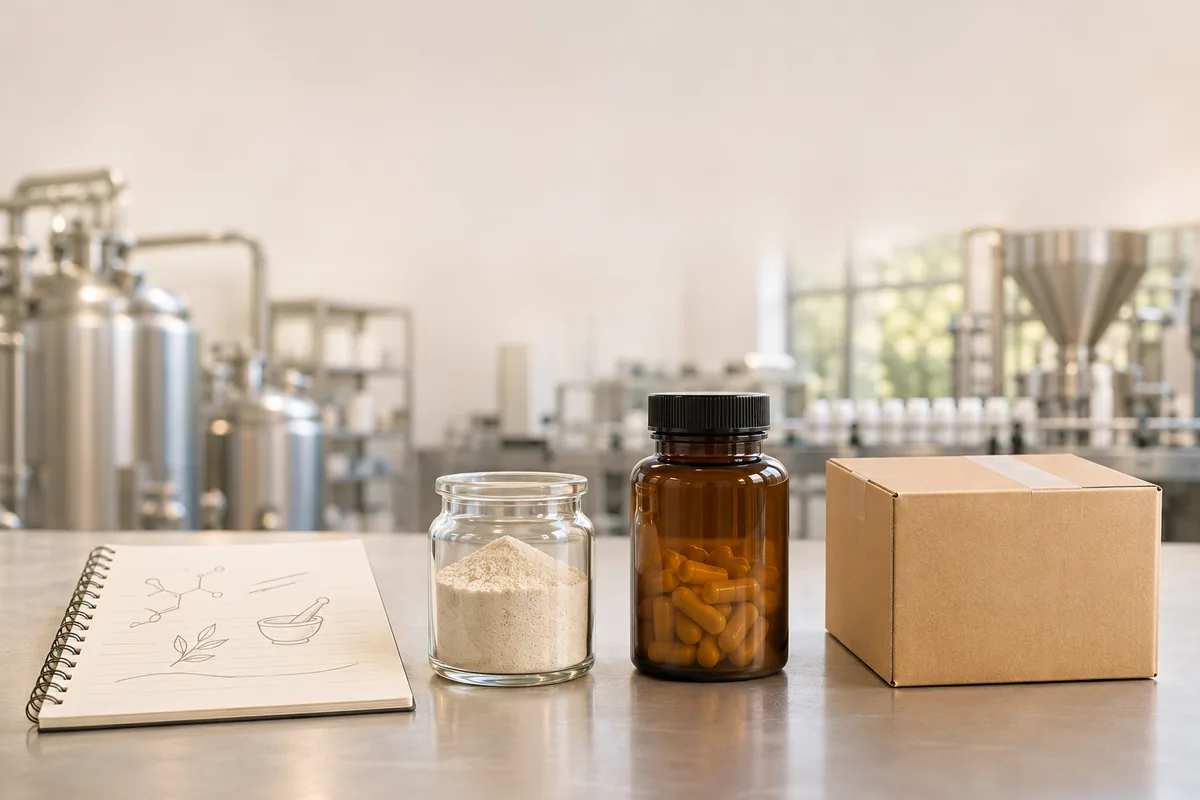
Pet Immune Health Supplement OEM: From Formula Development to Shelf-Ready Products
Part of: Pet Immunity Supplements: A Guide for Brands, Buyers and Formulators
Quick answer
What is the pet supplement OEM process? Pet supplement OEM (Original Equipment Manufacturing) involves 8 stages: 1) Initial Consultation (1-2 weeks), 2) Formula Development (4-8 weeks), 3) Sample Production (2-4 weeks), 4) Packaging Design (3-6 weeks), 5) Regulatory Review (2-4 weeks), 6) Full Production (20–25 working days), 7) Logistics Setup (1-4 weeks), and 8) Market Launch. Total timeline: 16-36 weeks (4-9 months). Custom manufacturing offers unique formulations with higher margins but requires more time and investment than wholesale products.
Introduction: Understanding the OEM Journey
Launching a pet immune health supplement under your own brand requires navigating a complex manufacturing process. Whether you're developing a unique formula or customizing an existing one, understanding the OEM (Original Equipment Manufacturer) journey ensures a successful partnership and high-quality outcome.
As you evaluate potential manufacturing partners, this guide walks you through every stage of the custom manufacturing process, from initial concept to shelf-ready products.
The Complete OEM Process: 8 Key Stages
Stage 1: Initial Consultation & Needs Assessment
Duration: 1-2 weeks
- Define product goals and target market
- Identify key immune-support ingredients
- Establish budget and timeline expectations
- Discuss regulatory requirements for target markets
Key Activities
Discovery Meeting
- Discuss your brand vision and market positioning
- Review competitive landscape
- Identify target customer demographics
- Define product differentiation strategy
Technical Assessment
- Evaluate ingredient options for immune support
- Discuss dosage forms (tablets, chews, powders, liquids)
- Review bioavailability and palatability considerations
- Assess regulatory requirements for target markets
Business Planning
- Establish project budget and investment parameters
- Define timeline and milestone expectations
- Discuss MOQ and production volume requirements
- Review pricing structure and profit margins
Deliverables
- Product brief document
- Preliminary ingredient list
- Budget estimate and cost breakdown
- Project timeline with milestones
- Regulatory requirements checklist
Questions to Prepare
| Category | Key Questions |
|---|---|
| Product Goals | What specific immune benefits should the product provide? |
| Target Market | Who is the target consumer (breed, age, health condition)? |
| Product Form | What product form is preferred (tablet, chew, powder, liquid)? |
| Certifications | What certifications are required (GMP, organic, vegan)? |
| Timeline | What is your target launch date? |
| Budget | What is your total investment budget? |
Pro Tip: Come prepared with examples of competitor products you admire and specific ingredient requirements. This accelerates the consultation process.
Related Reading: Learn what to look for in a reliable manufacturer before starting your OEM journey.
Stage 2: Formula Development & R&D
Duration: 4-8 weeks
Objectives:
- Develop unique formulation based on product goals
- Optimize ingredient ratios for efficacy and safety
- Ensure palatability for pets
- Validate stability and shelf life
Key Activities
Ingredient Research & Selection
Common Immune-Support Ingredients for Pets
| Ingredient | Function | Typical Dosage (Dogs) | Evidence Level |
|---|---|---|---|
| Vitamin C | Antioxidant, immune cell support | 100-500mg/day | Strong |
| Vitamin E | Antioxidant, cell protection | 100-400 IU/day | Strong |
| Zinc | Immune cell function | 10-30mg/day | Strong |
| Echinacea | Immune stimulation | 100-300mg/day | Moderate |
| Probiotics | Gut health, immune regulation | 1-10 billion CFU/day | Strong |
| Beta-Glucans | Immune modulation | 50-200mg/day | Moderate |
| Omega-3 Fatty Acids | Anti-inflammatory | 500-2000mg/day | Strong |
| Colostrum | Immune factors | 100-500mg/day | Moderate |
| Astragalus | Immune support, adaptogen | 100-500mg/day | Moderate |
| Reishi Mushroom | Immune modulation | 100-500mg/day | Emerging |
Trending Ingredients (2026)
- Postbiotics - Next-generation gut health
- Functional Mushrooms - Lion's mane, turkey tail, chaga
- Adaptogens - Ashwagandha, rhodiola, holy basil
- Marine Collagen - Skin and joint support
- CBD/Hemp Extracts - Calming and anti-inflammatory
Formulation Design
Technical Considerations
| Factor | What It Means | Why It Matters |
|---|---|---|
| Bioavailability | How well nutrients are absorbed | Ensures efficacy |
| Palatability | Will pets eat it willingly | Compliance and results |
| Stability | Product maintains potency | Shelf life and safety |
| Compatibility | Ingredients work together | Prevents degradation |
| Safety | No harmful interactions | Pet health protection |
Dosage Form Selection
| Form | Pros | Cons | Suited to |
|---|---|---|---|
| Tablets | Precise dosing, long shelf life | May be hard for some pets to take | Daily supplements |
| Soft Chews | Highly palatable, easy to give | Shorter shelf life, higher cost | Treat-like supplements |
| Powders | Flexible dosing, mix with food | Less convenient, taste issues | Multi-pet households |
| Liquids | Easy absorption, flexible dosing | Messy, shorter shelf life | Picky eaters, seniors |
| Softgels | Protect sensitive ingredients | May be difficult for small pets | Oil-based ingredients |
R&D Process
- Literature Review & Ingredient Selection
- Prototype Formulation (2-3 options)
↓ Stability Screening ↓ Palatability Assessment ↓ Dosage Optimization ↓ Final Formulation Selection ```
Deliverables:
- Prototype formulations (2-3 options)
- Ingredient specification sheets
- Preliminary stability data
- Cost analysis per formulation
- Recommended dosage form
Related Reading: Explore top manufacturers with strong R&D capabilities for your custom development.
Stage 3: Sample Production & Testing
Duration: 2-4 weeks
Objectives:
- Produce small-batch samples of selected formulation
- Conduct comprehensive quality testing
- Validate palatability with real pets
- Initiate stability testing
Key Activities
Sample Production
- Small-batch manufacturing (100 units with a custom label and bottle, 500 units with a printed outer carton)
- Multiple samples for testing and evaluation
- Packaging prototypes for visual assessment
Quality Testing
| Test Type | Purpose | Timeline | Acceptance Criteria |
|---|---|---|---|
| Microbiological | Ensure no harmful bacteria | 3-5 days | Pathogens absent on the plate count |
| Heavy Metals | Verify safe contaminant levels | 5-7 days | Contaminants below the limits agreed in the specification |
| Potency | Confirm active ingredient levels | 3-5 days | Assay matches the label claim and the COA |
| Stability | Validate shelf life | 3-6 months (ongoing) | Maintains potency through expiry |
| Palatability | Pet acceptance testing | 1-2 weeks | Panel accepts the sample before release |
Palatability Testing
- Test with target pet population (breeds, ages)
- Measure acceptance rate and consumption speed
- Gather feedback from pet owners
- Adjust flavor if needed
Sample Evaluation
- Visual inspection (color, shape, size)
- Texture and consistency
- Odor and taste (for pets)
- Packaging functionality
Deliverables
- Finalized product samples
- Certificate of Analysis (COA)
- Palatability test results
- Preliminary stability report
- Recommended packaging specifications
Quality Checkpoint
- Review all test results
- Approve or request modifications
- Document any issues and resolutions
- Proceed to packaging development
Stage 4: Packaging Design & Development
Duration: 3-6 weeks
Objectives:
- Design primary packaging (bottles, pouches, blister packs)
- Create compliant label design
- Develop secondary packaging (boxes, inserts)
- Finalize all packaging specifications
Key Activities
Primary Packaging Selection
| Material | Pros | Cons | Suited to |
|---|---|---|---|
| PET Plastic | Lightweight, shatter-resistant, recyclable | Less premium feel | Mass market products |
| HDPE Plastic | Durable, chemical resistant | Not as transparent | Tablets, powders |
| Glass | Premium feel, inert | Heavy, breakable | Luxury positioning |
| Foil Pouches | Excellent barrier, flexible | Less shelf presence | Single-serve, samples |
| Blister Packs | Precise dosing, protection | Higher cost | Travel, compliance |
Label Design & Regulatory Compliance
Required Label Elements
- Product name and purpose
- Net quantity (count, weight, volume)
- Ingredient list (descending order by weight)
- Guaranteed analysis (active ingredients per serving)
- Feeding directions (dosage by pet weight)
- Manufacturer name and address
- Lot number and expiration date
- Warnings and cautions
- Storage instructions
Regulatory Claims
- Structure/function claims (supports immune health)
- Avoid disease claims (treats, cures, prevents)
- Substantiation requirements vary by market
- Professional review recommended
Secondary Packaging
| Component | Purpose | Considerations |
|---|---|---|
| Outer Box | Protection, branding | Design, durability, sustainability |
| Inserts | Instructions, marketing | Information clarity, branding |
| Seals | Tamper evidence | Security, compliance |
| Labels | Product information | Regulatory compliance, readability |
Design Process
- Brand Guidelines Review
- Concept Development (2-3 options)
↓ Regulatory Compliance Review ↓ Prototype Production ↓ Stakeholder Approval ↓ Final Artwork Preparation ↓ Production File Delivery ```
Deliverables:
- Final packaging prototypes
- Approved label artwork (print-ready files)
- Packaging specifications document
- Cost estimates for packaging components
- Regulatory compliance verification
Related Reading: Understand GMP certification requirements that affect packaging and labeling.
Stage 5: Regulatory Review & Compliance
Duration: 2-4 weeks
Objectives:
- Verify label claims and compliance
- Prepare regulatory documentation
- Ensure market-specific requirements are met
- Obtain necessary approvals
Key Activities
Label Claim Review
- Verify all claims are substantiated
- Ensure claims match target market regulations
- Review ingredient declarations
- Confirm dosage instructions are accurate
Regulatory Submission (if required)
| Market | Regulatory Body | Requirements |
|---|---|---|
| USA | FDA (CVM), FTC | No pre-approval, but claims must be substantiated |
| EU | EFSA | Novel food approvals, health claim regulations |
| Canada | CFIA, Health Canada | NHP registration for therapeutic claims |
| Australia | APVMA | Registration for therapeutic claims |
| UK | VMD | Similar to EU requirements |
Documentation Preparation
- Product specification sheets
- Ingredient dossiers
- Safety data
- Efficacy substantiation
- Manufacturing process descriptions
Compliance Verification
- Label format requirements
- Ingredient restrictions
- Dosage limits
- Warning statements
- Import/export documentation
Common Compliance Challenges
| Challenge | Solution |
|---|---|
| Disease vs. Structure/Function Claims | Use "supports immune health" not "prevents illness" |
| Ingredient Safety Documentation | Provide complete safety dossiers |
| Label Format Requirements | Follow market-specific guidelines |
| Import/Export Documentation | Work with experienced regulatory consultants |
Deliverables
- Compliance checklist completed
- Regulatory submission package
- Market-specific label versions
- Import/export documentation
- Regulatory approval confirmation
Stage 6: Full-Scale Production
Duration: 20–25 working days after formula, artwork and deposit confirmation
Objectives:
- Execute full production run
- Maintain quality standards throughout
- Complete all quality control testing
- Prepare finished goods for distribution
Key Activities
Pre-Production Preparation
- Raw material procurement and testing
- Equipment setup and calibration
- Production scheduling
- Quality control protocol review
Production Workflow
- Raw Material Procurement
- Incoming Inspection & Testing
- Ingredient Weighing & Blending
- Forming (Tablets/Softgels/Powders/Liquids)
↓ Coating/Encapsulation (if applicable) ↓ In-Process Quality Checks ↓ Packaging & Labeling ↓ Final Quality Inspection ↓ Warehousing & Inventory ```
Quality Control Checkpoints:
| Stage | Tests | Frequency |
|---|---|---|
| Incoming Materials | Identity, purity, potency | Every batch |
| In-Process | Weight, hardness, thickness | Hourly |
| Finished Product | Full panel testing | Every batch |
| Packaging | Label accuracy, seal integrity | Every batch |
Production Management
- Daily production reports
- Real-time quality monitoring
- Issue escalation procedures
- Progress tracking against timeline
Deliverables
- Finished goods inventory
- Batch production records
- Quality control reports
- Certificates of Analysis (COA)
- Production completion confirmation
Related Reading: Compare wholesale vs. custom manufacturing timelines to plan your production schedule.
Stage 7: Logistics & Distribution
Duration: 1-4 weeks
Objectives:
- Set up warehousing and inventory management
- Establish distribution channels
- Configure fulfillment processes
- Prepare for market launch
Key Activities
Warehousing Setup
- Climate-controlled storage (if needed)
- Inventory management systems
- FIFO (First In, First Out) procedures
- Security and access controls
Distribution Channel Selection
| Channel | Pros | Cons | Suited to |
|---|---|---|---|
| Direct-to-Consumer | Higher margins, direct customer relationship | Marketing costs, fulfillment complexity | Brand building, premium products |
| Retail | Volume sales, brand visibility | Lower margins, slotting fees | Mass market, established brands |
| Veterinary Clinics | Professional endorsement, premium positioning | Slower adoption, relationship building | Professional products |
| E-commerce Platforms | Wide reach, easy setup | Competition, platform fees | Market testing, niche products |
Fulfillment Setup
- Order processing systems
- Shipping carrier selection
- Returns and damaged goods handling
- Customer support protocols
Logistics Optimization
- Shipping cost analysis
- Delivery time optimization
- Packaging protection for shipping
- Tracking and notification systems
Deliverables
- Distribution strategy document
- Fulfillment process documentation
- Shipping logistics plan
- Customer support protocols
- Inventory management setup
Stage 8: Market Launch & Ongoing Support
Duration: Ongoing
Objectives:
- Execute market launch strategy
- Monitor product performance
- Gather customer feedback
- Plan for continuous improvement
Key Activities
Launch Execution
- Marketing campaign activation
- Sales channel activation
- Customer education and support
- PR and media outreach
Performance Monitoring
| What to watch | What good looks like | How often |
|---|---|---|
| Customer Satisfaction | Reviews read in full, not scored | Monthly |
| Returns | Reasons for returns, not just the count | Monthly |
| Reorder Rate | Which buyers come back, and for which SKU | Quarterly |
| Sell-through | Rate of sale per channel, against the original plan | Quarterly |
| Quality Complaints | Complaints traced back to a batch or a specification | Monthly |
Customer Feedback Collection
- Product reviews and ratings
- Customer surveys
- Support ticket analysis
- Social media monitoring
Continuous Improvement
- Formula optimization based on feedback
- Packaging improvements
- New product development
- Market expansion planning
Ongoing Support Services
- Reorder management
- Quality issue resolution
- Regulatory updates
- Technical support
- New product development assistance
Deliverables
- Launch performance report
- Customer feedback analysis
- Improvement recommendations
- Reorder planning
- Future product roadmap
Timeline Summary: OEM Process Overview
| Stage | Duration | Key Milestone | Dependencies |
|---|---|---|---|
| 1. Consultation | 1-2 weeks | Project brief approved | None |
| 2. Formula Development | 4-8 weeks | Prototype formulations ready | Stage 1 complete |
| 3. Sample Production | 2-4 weeks | Finalized samples approved | Stage 2 complete |
| 4. Packaging Design | 3-6 weeks | Packaging finalized | Stage 3 complete |
| 5. Regulatory Review | 2-4 weeks | Compliance approved | Stages 3-4 complete |
| 6. Production | 20–25 working days | Finished goods ready | Stages 3-5 complete |
| 7. Logistics | 1-4 weeks | Distribution setup | Stage 6 complete |
| 8. Launch | Ongoing | Market entry | Stage 7 complete |
Total Timeline: 16-36 weeks (4-9 months)
Production itself takes 20–25 working days after the formula, artwork and deposit are confirmed (fastest 10–15 working days when capacity allows); the weeks above cover formula development, sampling, packaging and regulatory review.
Timeline Optimization Tips:
- Overlap stages where possible (e.g., start packaging design during formula development)
- Use pre-approved ingredients to reduce regulatory review time
- Choose manufacturers with fast turnaround capabilities
- Plan for buffer time for unexpected delays
Related Reading: Find manufacturers with fast turnaround to optimize your timeline.
Budget Considerations: OEM Investment Breakdown
Typical Cost Components:
| Component | What drives it | When it lands |
|---|---|---|
| Formula Development | How far the formula moves from a base the manufacturer already runs | Front-loaded, before any production |
| Sample Production | How many rounds and how many variants you test | Before the deposit, usually credited against the first order |
| Packaging Design | Standard pack versus a new tooled format | After the sample is approved, and again with every new format |
| Regulatory Review | How many markets you enter and how novel the actives are | Before production, per market |
| First Production Run | MOQ tier, format and ingredient load | The largest line, and the one MOQ moves most |
| Logistics Setup | Incoterms, destination, and whether you use your own forwarder | Per shipment, not once |
| Total | Follows the six lines above; no single figure fits every formula | Quoted after the brief, not before it |
Cost Optimization Strategies:
Formula Development
- Use manufacturer's existing bases to reduce development time
- Start from ingredient combinations the line already runs
- Limit custom flavor development initially
Sample Production
- Combine sample and first production runs when possible
- Use samples for market testing to validate demand
- Negotiate sample costs against first order
Packaging Design
- Use manufacturer's standard packaging options initially
- Invest in premium packaging for hero products only
- Design for scalability from the start
Production
- Start with smaller MOQs to reduce initial investment
- Negotiate volume discounts for future orders
- Optimize production scheduling for efficiency
Choosing the Right OEM Partner
Essential Qualities:
Technical Capabilities
- ✅ In-house R&D team
- ✅ Multiple product form capabilities
- ✅ Modern equipment and technology
- ✅ Comprehensive testing capabilities
- ✅ Flexible production capacity
Quality Systems
- ✅ GMP certification
- ✅ Third-party testing
- ✅ Documented quality procedures
- ✅ Traceability systems
- ✅ Corrective action processes
Business Practices
- ✅ Transparent communication
- ✅ Flexible MOQ options
- ✅ Competitive pricing
- ✅ Reliable timelines
- ✅ Strong customer support
Red Flags:
Technical Red Flags
- ❌ Limited product form options
- ❌ Outdated equipment
- ❌ No in-house R&D
- ❌ Minimal testing capabilities
Quality Red Flags
- ❌ No GMP certification
- ❌ Reluctance to provide documentation
- ❌ History of quality issues
- ❌ No third-party testing
Business Red Flags
- ❌ Poor communication
- ❌ Unrealistic promises
- ❌ No client references
- ❌ Unwillingness to document agreements
Related Reading: Use the 7 key factors framework to evaluate potential OEM partners.
What a typical OEM project looks like
Every project starts from a brief, not from a catalogue. The three stages below are the order we run; the calendar comes from the client's market and documentation, not from a fixed template.
1. Formula and specification
- Agree the species, the daily serving and the claims the label will carry.
- Match actives to ingredients that are permitted in the destination market.
- Produce prototype options and review palatability before the formula is locked.
2. Sampling and packaging
- Produce samples for internal testing and, where the market requires it, stability review.
- Fix the packaging format and the artwork brief.
- Run the label and claims review that applies in the destination market.
3. Production and dispatch
- Confirm specifications, artwork and deposit, then schedule production.
- Test the finished batch and release it against the approved specification.
- Ship to the client's warehouse or fulfilment partner.
What moves is the work in front of production. A new formula, a new pack and a new market each add review time, which is why we quote after the brief and not before it.
Common questions
How long does production take?
20–25 working days from the point the formula, artwork and deposit are confirmed. An expedited run takes 10–15 working days when capacity allows. Samples take 3–5 working days and that is a separate clock.
How does an OEM project start?
With a brief, not a catalogue. The brief fixes the market, the species, the format, the target actives and the claim boundaries. Only after that is there a formula and a date.
Who owns the formula?
That is a contract term, and the answer depends on what you agree. Raise it before signing and get it in writing, because it decides whether you can move production to another supplier later. Ask separately about components bought from third-party ingredient makers.
Can I start with 100 units?
Yes. The minimum is 100 units per SKU, including a custom label and bottle. A printed outer carton raises the threshold to 500 units. The formula is the same across all our formats.
What do the samples include?
Four parts: raw material for the trial batch, making the samples, laboratory checks and shipping. The further the formula sits from a base the plant already runs, the larger the trial batch and the more iterations it takes. We quote after the brief.
Do I need NASC certification?
That depends on the market and the channel. In the US it is a recognised trade mark for animal supplements and it helps in some channels. Elsewhere it is optional. Decide by where you sell and what your buyer asks for.
What is FDA registration?
A registration of the production facility. The plant notifies the regulator that it makes feed supplements and receives a number. The product is not approved by the regulator, and there is no «FDA approval» for supplements.
Can the formula be changed after the first batch?
It can, but it is not a one-line edit. A new composition needs new samples and a repeat stability check, and the label is redone because the ingredient list and the claims have to match what is in the tub. Budget the time before the next batch, not after it.
Conclusion: Your Path to Market with OEM Manufacturing
The OEM process for pet immune health supplements is complex but rewarding. By understanding each stage—from formula development to shelf-ready products—you can plan effectively, choose the right partners, and launch products that meet quality standards and market demands.
Key Takeaways:
1. Plan for 4-9 months from concept to market launch
2. Budget against those cost lines, not against a headline figure, and settle the MOQ tier before the first production run
3. Choose manufacturers with strong R&D capabilities and quality systems
4. Start from ingredients the line already runs to shorten development and cut risk
5. Build in buffer time for unexpected delays and iterations
Next Steps:
1. Define your product vision and target market 2. Research potential manufacturing partners 3. Request consultations and quotes 4. Begin your OEM journey with a clear plan
Ready to start your OEM project? Explore our manufacturer evaluation guide or contact our team to discuss your custom pet supplement needs.
Related Articles
Essential Reading for Pet Supplement Buyers
- How to Find a Reliable Pet Immunity Health Vitamin Manufacturer: 7 Key Factors — comprehensive manufacturer evaluation guide
- 2026 Guide: Top Pet Immunity Vitamin Manufacturers with Low MOQ — top manufacturers with low MOQ
- Wholesale Pet Immunity Vitamins: GMP-Certified Manufacturer Guide — GMP certification requirements