
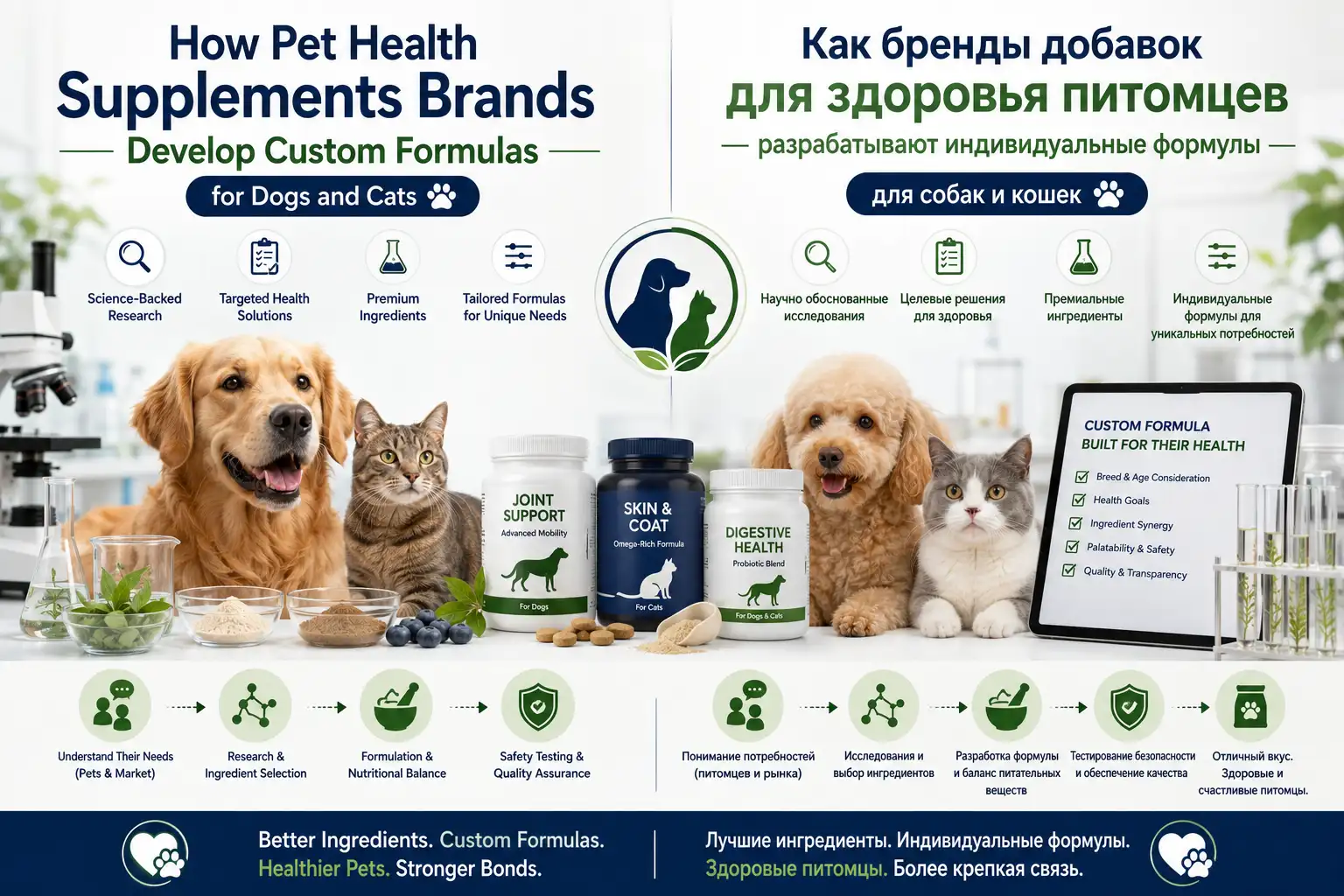
How Pet Health Supplements Brands Develop Custom Formulas for Dogs and Cats
Developing a custom pet supplement formula is not like picking flavours off a menu. It runs through distinct stages, and the calendar is set by the slowest one rather than by the fastest promise. Skipping a stage does not save the time; it moves the cost to a reformulation later.
The brands that get through it follow a repeatable process rather than a rushed one, and the two behave differently inside the same plant.
Step 1: Define the Functional Target Before Talking Ingredients
The biggest mistake new brands make is jumping straight into ingredients. "We want a joint chew with glucosamine and turmeric" sounds specific, but it skips the most important question: what problem are you actually solving?
Custom formulation starts with a clear functional brief. For example:
- "A daily soft chew for senior dogs over 7 years old, targeting mobility and stiffness"
- "A powder formula for cats with recurring hairballs and digestive sensitivity"
- "A calming chews blend for dogs experiencing separation anxiety during work hours"
Each of these targets a different mechanism, different active levels, and different flavor profiles. A manufacturer can't formulate effectively without this context. For instance, brands often start with joint support chews for dogs.
Step 2: Ingredient Selection and Dose Optimization
Once the target is defined, the formulation team works on ingredient selection. This is where industry experience matters most.
For a typical dog joint support formula, the ingredient shortlist might include:
- Glucosamine HCl — the base of any joint formula; the level follows body weight
- MSM — pairs with glucosamine; the ceiling depends on the format
- UC-II collagen — a low-inclusion ingredient where the cost sits in the material
- Turmeric extract, standardised to curcuminoids — the standardisation matters more than the amount
- Vitamin E — an antioxidant here, specified in IU
Where each level lands depends on the target weight range, the format, and whether the formula is for daily maintenance or for a narrower use your market lets you claim. That conversation is what a formulator is for.
An experienced manufacturer will talk about bioavailability rather than about milligrams on the label. Curcumin is the standard example: on its own it is poorly absorbed, and the formulation work goes into the delivery — a standardised extract, a lipid carrier, or black pepper extract alongside it. What separates a commodity plant from one that formulates is knowing which of those the format can actually carry. Skin and coat chews for dogs are a useful test case, because the actives there are only worth including if they survive the chew.
Step 3: Format Selection Drives Everything
The formula format affects costs, stability, and compliance more than any other decision. Here's how the three main options compare for custom formulas:
| Format | What sets development time | What sets shelf life | Pet Acceptance |
|---|---|---|---|
| Powder | Blending and moisture control | Moisture pick-up and packaging barrier | Moderate (needs mixing) |
| Soft chew | Texture and flavour trials | Water activity and preservative system | High (treat-like) |
| Liquid | Palatant and emulsion stability | Preservative system and bottle seal | Moderate (palatant-dependent) |
Soft chews have the longest development time because the texture is difficult to get right. Too hard and pets won't eat them. Too soft and they don't hold their shape during packaging. Most brands I've worked with go through several rounds of trial batches before approving a soft chew texture.
Production itself takes 20–25 working days after the formula, artwork and deposit are confirmed (fastest 10–15 working days when capacity allows); the weeks above cover formula development, sampling, packaging and regulatory review.
Powders are faster to develop but put the work on the owner, who has to mix them into food every day. That is where compliance slips: not at the first scoop, but in the third week. Probiotic powder for dogs and cats is the format where that trade-off is clearest — cheap to make, easy to sell once, hard to keep in the bowl.
Step 4: Palatability Testing Is Non-Negotiable
A formula that pets won't eat is worthless, no matter how good the ingredient list is. Professional custom formulation includes palatability trials — typically a two-bowl test where pets choose between the new formula and a control.
Acceptable palatability scores for commercial launch are:
- Dogs — take to a chew quickly, and the trial usually shows it in the first sitting
- Cats — more selective; a formula that passes with dogs can still fail here, so the trial has to be run on cats
Natural flavor enhancers like chicken liver powder, salmon oil, and yeast extract are commonly used to improve acceptance without adding artificial flavors.
The expensive order of operations is the common one: formula first, palatability last. When the trial fails at that point, the work is not a tweak — it is a reformulation, because the flavour system and the texture both have to change. Run the acceptance trial before the stability study, not after it.
Step 5: Stability Testing and Shelf-Life Validation
Stability testing is the longest phase of custom formulation and the easiest to underestimate. Samples go into accelerated conditions first — elevated temperature and humidity — to see how the product behaves in a compressed window, and then a real-time study runs alongside to confirm the shelf life you intend to print.
During the study, samples are pulled at set intervals and tested for:
- Active ingredient potency
- Microbial limits
- Moisture content
- Texture changes (for chews)
- Appearance and odor
A formula that looks great in the first month but degrades by month three needs reformulation. This is why rushing stability testing is a common and expensive mistake.
The Bottom Line
Custom pet supplement formulation is not a commodity service. The brands that succeed invest time upfront on the functional brief, choose their format based on real pet owner behavior, and budget for proper stability testing. A well-developed custom formula done right will perform in the market for years. A rushed one rarely survives the first production batch.