
Skin and Coat Supplements for Dogs: A Private Label Guide
A coat problem rarely starts at the coat. It shows there first because hair is the tissue a dog replaces fastest, so a skin and coat supplement is usually a nutrition product wearing a cosmetic promise.
That mismatch is where most new lines lose money. The buyer imagines an owner looking at a dull coat and reaching for a supplement, which is right, but the product that answers that moment has to deliver fat, zinc and a handful of vitamins in a format the dog will accept every day for weeks before anything visible changes.
Everything in this guide follows from that: a slow, invisible mechanism sold through a visible outcome. The formula has to be built for the mechanism, and the label has to stay honest about the outcome.
This is written for the buyer specifying a private label skin and coat line, not for the owner shopping one.
Why this category is a formula problem
Coat condition depends on protein quality, fat profile, zinc, and a few vitamins that sit inside the skin barrier. None of that is fixed by a topical product, and none of it changes in a week.
The visible part of the category is the photograph on the pack: a glossy coat, a bright eye, a dog on a lawn. The invisible part is what the formula has to do to make that photograph a fair description of a normal dog on a normal diet. That work happens at the ingredient level, and it is slow.
There is a second reason this is a formula problem. Skin and coat claims are the easiest in the supplement category to overreach, because the outcome is visible and the timeline is long enough that buyers feel entitled to promise it. A line built on a promise that cannot be kept produces refunds and reviews, not repeat purchase.
The pack can only promise what the formula supports, over a period long enough for the owner to see it.

The ingredients buyers ask for, and what each does
Most enquiries about this category name the same four things, and it helps to know what role each one plays in a formula rather than what a brochure says about it.
Omega-3 fatty acids are the anchor. EPA and DHA are the parts of a fish or algal oil that the body uses in cell membranes, and the skin is a tissue with a fast turnover, which is why fat quality shows up in the coat. This is the ingredient that carries the category, and it is also the one most exposed to oxidation.
Zinc is the second common request. It is involved in skin maintenance and wound repair, and it is the ingredient most often under-supplied in a cheap formula because a meaningful level costs money and tastes metallic.
Biotin and the B group appear in most panels. They are cheap, they are familiar to owners, and they are usually present at levels that satisfy the label rather than the mechanism.
Vitamin E does two jobs here, and only one of them is nutritional. It is an antioxidant, so in an oil-bearing formula it protects the oil as much as it supplements the dog. That overlap matters when the formula is being costed: the level that stabilises the fat may be the level that is also claimed.
Collagen and marine ingredients appear in newer formulas for the connective tissue story, and they are legitimate additions as long as the panel has room for them without squeezing the omega-3 level that the category is actually bought for.
Four names on a panel, one of which is doing most of the work.
Omega-3 sourcing decides the rest of the formula
The single decision that shapes a skin and coat formula is where the omega-3 comes from, because the source sets the fatty acid profile, the taste, the allergen statement and the oxidation risk.
Fish oil brings EPA and DHA together in a profile owners recognise, and it carries a fishy note that has to be masked in a chew. It also brings a supply chain with variability in origin, and buyers increasingly ask about fishery certification, which is a sourcing question rather than a quality one.
Algal oil brings DHA in a plant-based profile, and it avoids fish protein, which matters for the allergen statement. It is not automatically cleaner or more stable: it can carry residual fermentation media, and it oxidises like any other oil. The trade-off is positioning and allergen risk, not purity.
Either way, the enemy is oxidation. A peroxidised oil smells and tastes wrong, and it delivers less of what the label claims. Peroxide value and anisidine value are the numbers that describe this, and a supplier who cannot report them for the oil it buys is asking you to take the risk on trust.
Ask for the oil specification, the oxidation limits and the test method before discussing price. The cheapest oil is usually the one that has already started to go.
If the sourcing decision is still open, the comparison of algal oil and fish oil for pet supplements goes through the fatty acid profiles and the allergen consequences in more detail than this section does.
Palatability is the real constraint in a chew
The chew is the format most owners buy, and the chew is where the formula fights itself.
An oil-bearing chew has to hide two tastes at once: the fish note from the omega-3 and the metallic note from the mineral. Masking agents work, but they take room in the base, and the room they take comes out of the oil load. A formula that tastes good and carries a token oil level is a packaging product.
The practical way around it is to separate the questions. First decide the oil level the formula has to carry to be worth selling. Then decide the base and the masking system that can carry it. A supplier who starts from the flavour and works backwards will land on a formula that smells pleasant and does little.
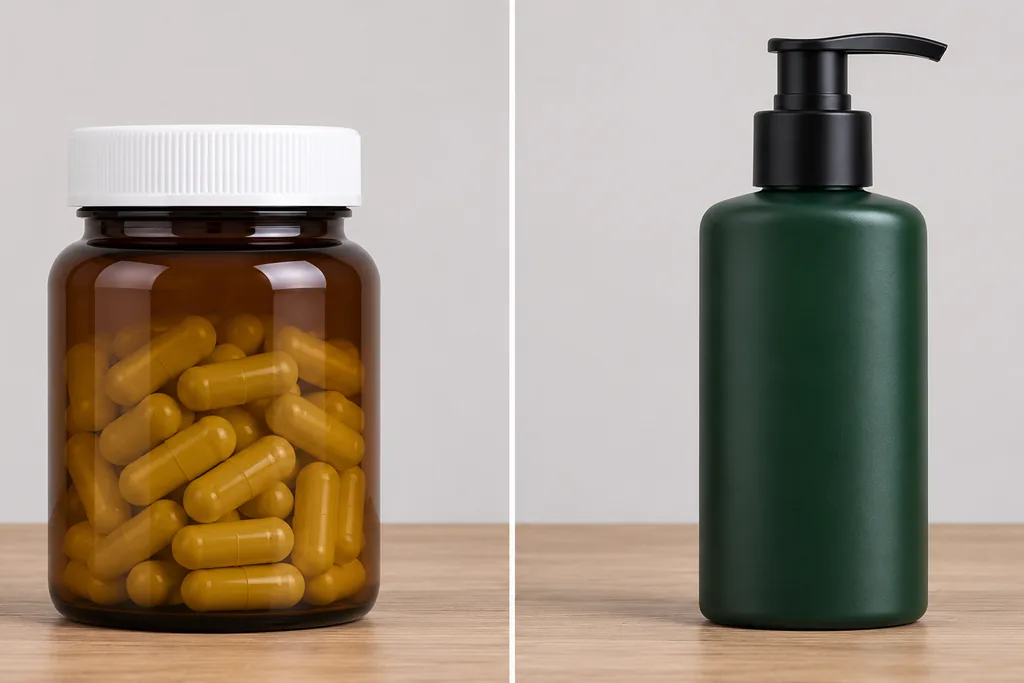
Powder avoids most of this, because it is mixed into food and the food does the masking. Drops avoid it differently, by being dosed over food in small volumes. Both are legitimate formats for this category; neither is as easy to sell as a chew.
Taste is a formula constraint, not a marketing one.
Claims: support the coat, not treat the skin disease
Skin and coat is the category where claim discipline pays for itself fastest, because the disease side of it is crowded and regulated.
Support language describes normal function: supporting normal skin condition, supporting a glossy coat, supporting the skin barrier as part of a normal diet. These statements describe a body working as it should, and a documented formula can defend them.
Disease language describes a condition: treating dermatitis, resolving a yeast infection, curing an allergy. A pack that says "stops itching from allergies" is making a medical claim, and in most markets that moves the product into a different regulatory category with a different evidence standard. That sentence is the example of what not to write, and it is worth showing to whoever drafts the artwork so it does not return in softer wording.
The middle ground catches brands here more than anywhere else, because the outcome is visible. "Supports skin comfort during seasonal shedding" is a support claim. "Stops seasonal itching" describes a result in a condition. The formula is identical; the regulatory position is not.
Write the claim first, then design the pack around it.
What to test, and how often
Testing in this category has two layers, and they answer different questions.
The first is the oil. Peroxide value, anisidine value and a fatty acid profile tell you whether the oil is sound at intake and what EPA and DHA it actually delivers. These are the numbers that turn a sourcing claim into a specification, and they should be re-checked per lot, not once at the start of a relationship.
The second is the finished product. A stability run shows whether the oil survives the process and the shelf life without turning, and whether the vitamin E level is doing its antioxidant job as well as its nutritional one. Panel verification on the finished piece shows whether the declared levels are present after the chew has been formed and dried.
Retained samples close the loop. If a complaint arrives six months later, the retained sample is the only way to find out whether the batch was wrong or the pack was stored badly.
Ask which of these the plant does in-house and which it sends out. The answer tells you more about the plant than any certificate.
MOQ, formats and the first SKU
The commercial terms are the same across formats on this site, which makes the format decision a technical one.
A first order is 100 units per SKU with a custom label and bottle. A printed outer carton raises the threshold to 500 units, because the carton is a separate print item with its own minimum. Samples take 3–5 working days. Production runs 20–25 working days from confirmed formula, artwork and deposit, with an expedited run at 10–15 working days when capacity allows.
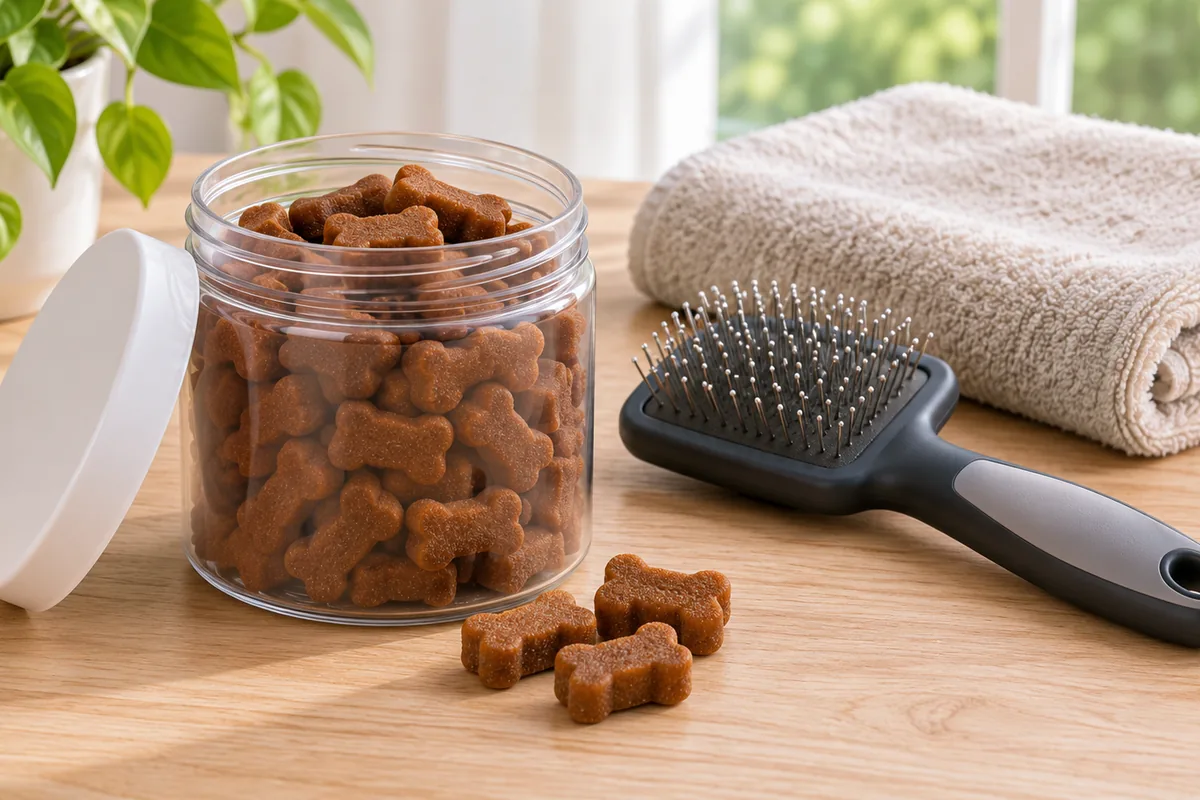
For a first SKU, a chew is usually the right choice in this category because it is what the shelf already sells and it tests the hardest problem, the masking of the oil. If the chew works, the powder and the drops extend the line without new formulation risk. If the chew does not work, you have learned that before paying for three formats.
Skin and coat chews for dogs is the format most private label brands start with for exactly that reason, and the panel work goes into the oil level rather than the shape of the piece.
Start with the format that tests the hardest constraint.
FAQ
How much omega-3 should a skin and coat supplement have?
There is no single figure that fits every product, and a number copied from another pack is not a specification. What a buyer can ask is how the level was set, whether the finished product is tested for EPA and DHA rather than for total oil, and whether the formula still delivers that level at the end of shelf life. A supplier who answers those three questions has a formula; one who quotes a number without a basis is quoting a label.
Do skin and coat chews actually work?
They can support normal skin and coat condition, and that is the honest boundary. Hair turnover is slow, so nothing visible happens in a week, and the evidence for any single ingredient is not a guarantee for your formula. What a buyer should not do is promise a visible result by a date. What a buyer can do is make sure the oil level is real, the product is eaten daily, and the claim stays inside support language.
Is fish oil or algal oil better for coats?
They deliver omega-3 through different profiles, so the choice is about positioning and allergen risk rather than a ranking. Fish oil brings EPA and DHA together and carries a fish note that has to be masked. Algal oil is plant-based and avoids fish protein, which helps the allergen statement, but it oxidises like any oil and is not automatically cleaner. Ask both suppliers for oxidation values and fatty acid profiles, then decide.
What is the minimum order for a skin and coat line?
100 units per SKU with a custom label and a bottle. Adding a printed outer carton raises the minimum to 500 units. The formula tier does not change, so a 100-unit trial and a 500-unit run can use the same formula.
Can I claim it treats allergies or dermatitis?
No. Dermatitis and allergies are diagnosed conditions, and a claim to treat them is a medical claim that moves the product into a different regulatory category. Support language is what this category can use: supporting normal skin condition, supporting a glossy coat, supporting the skin barrier. The formula still has to be documented and the artwork reviewed against the claim.
Can the same product be sold for cats?
Usually with a change of format rather than a change of formula. Cats are smaller, they are pickier about taste, and a chew sized for a dog is not always accepted. A powder mixed into wet food or a drop dosed over food is often the easier route for cats, and the label and the serving basis have to be reviewed separately for the two species rather than copied across.
Work backwards from the pack. Decide the oil level the formula has to carry, then the oxidation limits you will accept on the raw material, then the format that can carry that oil without ruining the taste. Only after those three are settled does the rest of the panel make sense, because every additional ingredient competes for the same room.
If you are at that stage, send the format, the target market and the omega-3 source you have in mind. We will tell you what the base can carry, what the first batch can verify, and where the claim has to stop.