
Probiotic Supplements for Dogs: A Private Label Guide
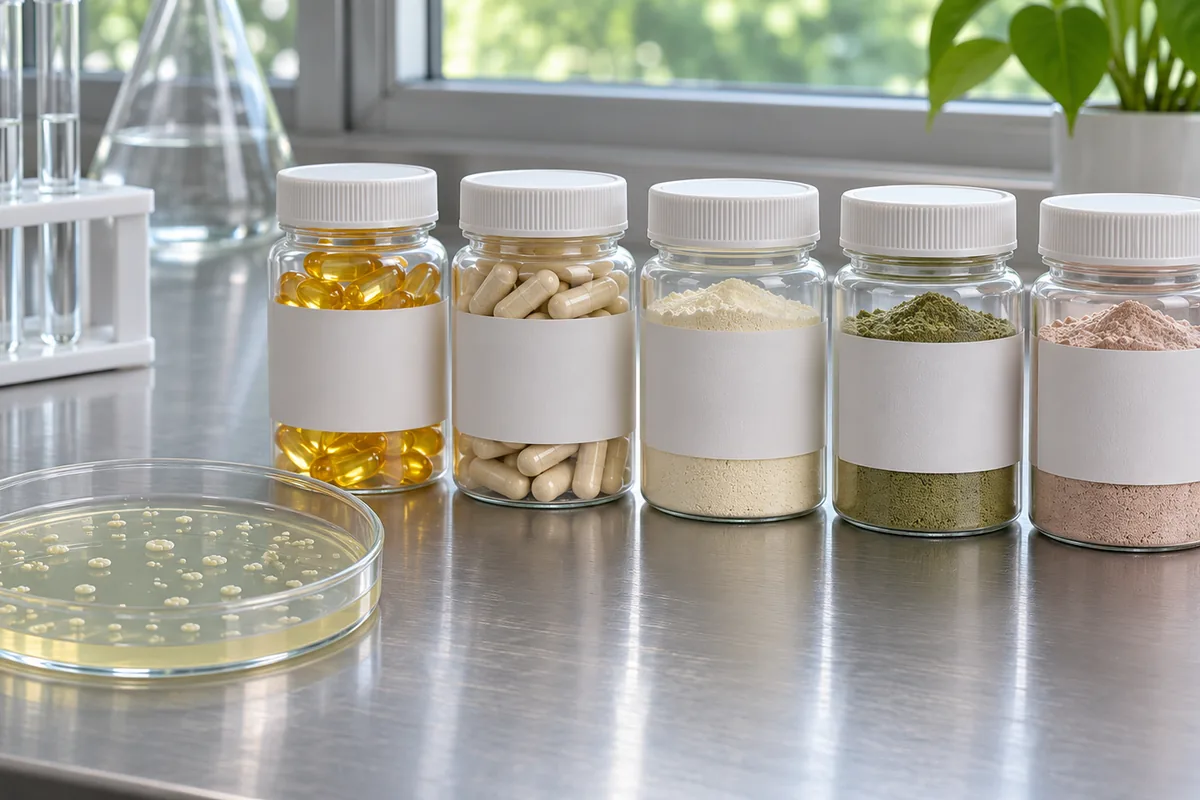
The hard part of a probiotic line is not choosing a strain. It is keeping live organisms alive until the pack is empty, because formula, moisture and packaging decide together whether the number on the label is still true at the end of shelf life.
Most buyers arrive at this category after working on vitamins or chews, and they assume the work is the same. It is not. A vitamin can be assayed, blended and sealed with confidence; a live culture is a process that keeps running after the pack is closed. Every decision from the freeze-dried culture order to the desiccant sachet either protects that population or slowly spends it.
This guide is written for the buyer who is specifying a private label probiotic line for dogs and needs to know what to put in writing before a purchase order exists.
Why the label number is the hardest part
A CFU figure is a count taken at one moment on one sample. It is not a property of the product in the way a protein percentage is a property of a meat. Live cells decline, and they decline faster in warmth and moisture, so the figure at release is the high point of a curve that only goes down.
That has a practical consequence for the label. If the pack states a count at release, the buyer at month twelve is holding a product that no longer matches the number in print, even though nothing was done wrong. Most markets expect the label figure to hold to the end of shelf life, which means the formula needs headroom at release and the shelf life claim needs testing rather than assumption.
The second consequence is in the paperwork. A certificate of analysis that reports a count without saying when it was measured, and on what basis of storage, answers a question nobody asked. Ask for the method, the sample date and the storage condition the number refers to.
A count without a date is a wish.
Strains: what actually differs
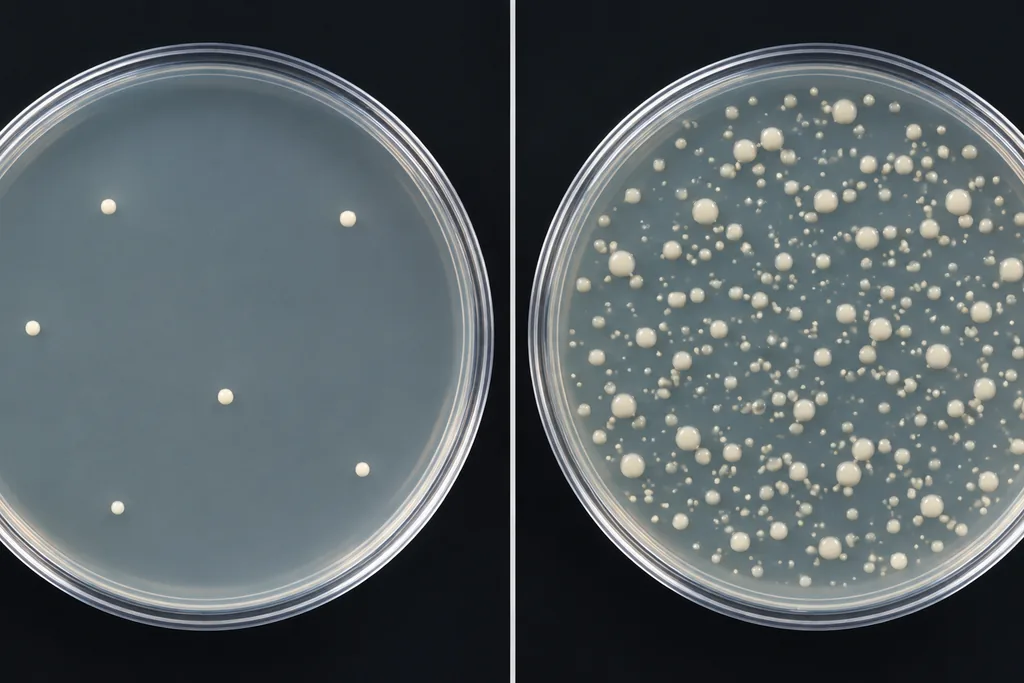
Probiotic is a category word, not an ingredient. Underneath it sit genera, species and strain designations, and the strain level is where the specificity lives. Two products can both say *Lactobacillus* and share neither a strain nor a manufacturing tolerance.
For a buyer, the strain designation does three jobs. It tells you what the culture house supplied, it makes the label claim checkable, and it gives the plant something to match when a raw material lot changes. A formula written as "probiotic blend" with no designations cannot be verified by anyone, including the brand that paid for it.
Blends are common for reasons that are mostly technical. Different organisms tolerate different parts of the process: one handles the drying step, another survives compression, a third keeps its count in a chew base that spends time at elevated temperature. A blend is also a way to spread risk, because a single culture in a single format has a single failure mode.
None of this makes a blend more effective than a single strain. It makes it more forgiving to manufacture, which is a different claim and a safer one.
A genus name tells you almost nothing.
Moisture, heat and the process
Three formats dominate this category, and each one stresses a live culture differently.
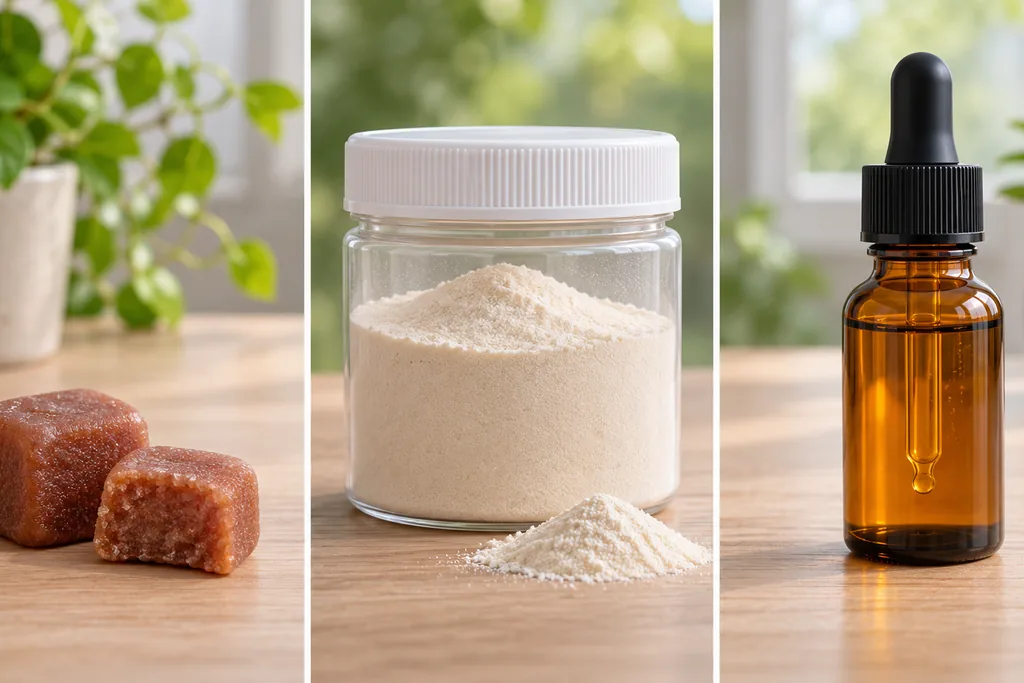
Soft chews are the friendliest to sell and the least friendly to biology. The base is cooked or extruded, which means heat, and afterward the chew holds water that keeps migrating. Water activity is the number that matters here, not moisture percentage: it describes the water available to react, and a culture sitting in a high-activity matrix loses viability even when the pack looks dry. That is why a chew formula needs either a lower activity base, a protective coating, or both.
Powder is the easiest place to hold a count. Dry blending keeps the culture away from water and heat until the consumer opens the jar, and the whole problem reduces to humidity control at the plant, the seal, and what happens after opening. The trade-off is consumer acceptance: a powder has to be measured and mixed, which many owners will not do daily.
Liquids are the hardest. A water-based product gives the culture a medium to sit in, and stability work becomes a race between the organism and everything else in the bottle. Some formats are feasible, but they are specified as a stability project rather than a formula, and the shelf life claim usually carries more conditional language.
Water is what does the damage, not the organism.
What to test, and when
A viable testing plan has four parts, and a plant that can describe all four has done this before.
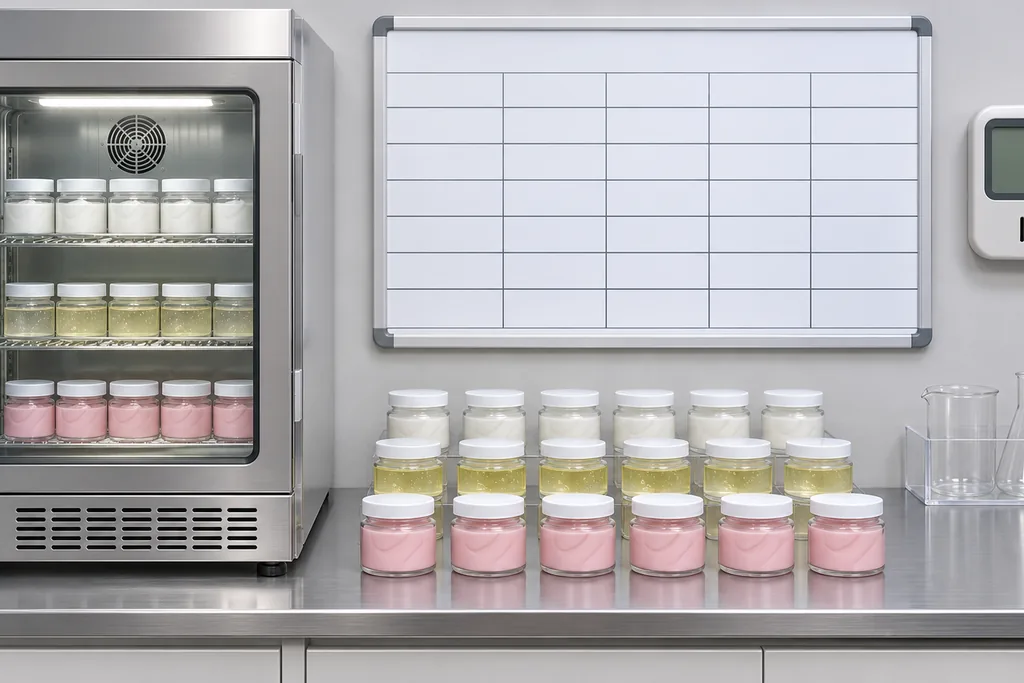
The first is a release count on the finished batch, with the method named. The second is an accelerated stability run, usually at elevated temperature and controlled humidity, sampled at intervals so the decline curve is visible rather than guessed. The third is real-time data at ambient conditions, which nobody wants to wait for and which is the only data that describes the actual product. The fourth is a retained sample set, so a count can be re-run later against the same batch if a customer complaint or an audit demands it.
Accelerated data is a model, and models are worth what their assumptions are worth. A culture that holds at elevated temperature often holds at ambient, but the extrapolation needs a real-time point to anchor it, especially for chews where the matrix keeps changing after packing.
The question to ask is not whether the plant tests. It is which of the four parts it can show you for a formula close to yours, and what it does when a count comes in below the specification. A plant that has an answer for the second question has a system; a plant that has an answer only for the first has a laboratory.
Test the end, not only the start.
Choosing a manufacturer for a live-culture line
The useful questions here are narrow enough that a supplier either has the answers on file or has to invent them, and the difference shows in the first reply.
Ask which culture house supplies each strain, and whether the strain designation on the specification is the one that will appear on the certificate of analysis. Ask how the plant holds viability through its own process step, in its own words, with the parameter it controls. Ask for the water activity specification of the chew base, and for the packaging: foil, desiccant, induction seal, and what the specification says about the pack after opening. Ask which laboratory runs the counts and whether the method is named in the report.
Then ask what changed in the last twelve months. Probiotic suppliers change culture suppliers, drying methods and packaging more often than they change vitamins, and a plant that can describe its last change in detail is a plant that monitors its own process.
If you are still shortlisting, the wider checklist for choosing a manufacturer for private label supplements covers the commercial and audit side of that decision, which this section deliberately does not repeat. What matters here is that the live-culture questions are asked before the price conversation, because they change what the price is for.
Ask for the batch record, not the brochure.
Claims: support, not cure
Gut health claims split cleanly into two groups, and the line between them is not a matter of tone.
Support language describes normal function: supporting normal digestion, supporting a balanced gut environment, supporting normal stool quality. These statements are about the body working as it should, and they are what this category can defend when the formula is documented and the label is reviewed.
Disease language describes a condition: treating diarrhoea, managing inflammation, helping with a diagnosed gastrointestinal disorder. A product that claims to treat a condition is making a medical claim, and in most markets that moves it into a different regulatory category entirely, with different evidence expectations. A label line such as "helps stop diarrhoea in three days" is the example of what not to write, and it is worth showing that sentence to whoever drafts your artwork so nobody reintroduces it.
There is also a middle ground that catches brands: language that starts as support and drifts into outcome. "Supports digestive comfort during stress" is a support claim. "Ends stress-related stomach upset" describes a result in a condition, and the second one will be read as a treatment claim even if the formula is identical.
Keep the two vocabularies separate in the brief you give the label designer. Mixing them at the drafting stage is how a compliant formula ends up with a non-compliant pack.
Format, MOQ and the first batch
The commercial terms on this site are the same across formats, which makes the format decision a technical one rather than a budget one.
A first order is 100 units per SKU with a custom label and bottle. Adding a printed outer carton raises the threshold to 500 units, because the carton is a separate print item with its own minimum and its own proof cycle. Samples take 3–5 working days. Production runs 20–25 working days from the moment the formula, artwork and deposit are confirmed, and an expedited run can be scheduled at 10–15 working days when capacity allows.
Which format to start with depends on what you are trying to prove. A powder is the shortest path to a stable count, because the culture stays dry until the consumer opens the jar, and the process variables are fewer. A chew is the shortest path to repeat purchase, because it is the format owners actually give without measuring anything, but it puts the viability question in the middle of the project rather than at the end.
A first SKU that is easy to keep alive gives you clean stability data, and that data is what makes the harder format possible later.
Probiotic powder for dogs and cats is the format most private label buyers start with for exactly that reason: the moisture problem is bounded, and the shelf life claim is easier to stand behind.
Start where the process is easy to control, then move.
FAQ
How many CFU should a dog probiotic have?
There is no single figure that fits every product, and a number copied from another label is not a specification. What matters is that the count is stated with a basis: measured at release or held to end of shelf life, tested by a named method, on a named sample. Ask the manufacturer what its stability data supports for your format, then set the label figure to the number the product will actually hold at the end of the declared shelf life, not the number it shows on the day it is packed.
Do probiotics survive soft chews?
Some do, and the ones that do are chosen for it. The limit is not the chew itself but the water activity of the base and the heat the culture meets during processing. A chew with a high-activity base will lose count faster than a dry one, and a coating or a low-activity base is how that is managed. If a supplier says chews are no problem without asking about water activity, that answer is worth less than a slow one.
Can I put probiotics in a liquid?
It can be done, but it becomes a stability project rather than a formula decision. A water-based product gives the culture a medium, and keeping a count in that medium over shelf life takes specific work on the base, the pH, the packaging and the storage conditions. Expect a longer development cycle, more testing and a shelf life claim with more conditions attached. That is a legitimate product decision; it is not a shortcut.
What is the minimum order?
100 units per SKU with a custom label and a bottle. A printed outer carton raises the minimum to 500 units, because the carton is a separate print item. The formula tier does not change between the two: the same 100-unit formula can go into a 500-unit run with the carton added.
Do I need stability testing?
Yes, and the reason is the label rather than the paperwork. The count on the pack has to be true at the end of the declared shelf life, and only stability data can tell you what that number is. Accelerated data gives you a direction; real-time data at ambient conditions anchors it. A retained sample set lets you re-run the count later, which is what you will want if a customer or a distributor asks.
Can I claim it helps with diarrhoea?
No. Diarrhoea is a condition, and a claim to help with it is a disease claim, which moves the product into a different regulatory category. What this category can say is support language: supporting normal digestion, supporting a balanced gut environment, supporting normal stool quality. Those statements describe normal function, and they still need the formula and the records to be in place.
A probiotic line is specified backwards from the label. Decide the count you can defend at the end of shelf life, then choose the format that makes that count realistic, then choose the strains that survive that format, then test it and write the claim the data supports. Every step after the first is a consequence of the label figure, which is why the figure is worth settling before anything is ordered.
If you are at that stage, send the format, the target market and the shelf life you have in mind. We will tell you what the stability work looks like for that combination, what the first batch needs, and where the claim language has to stop.